
Gambling Open Data Ottawa
A sizable portion of all gambling activities in Canada is related to casinos. According to the Open Data Ottawa, gamblers pay close attention to both online and physical gambling facilities. All of the nation’s provinces have seen a rise in gambling net revenues year over year.
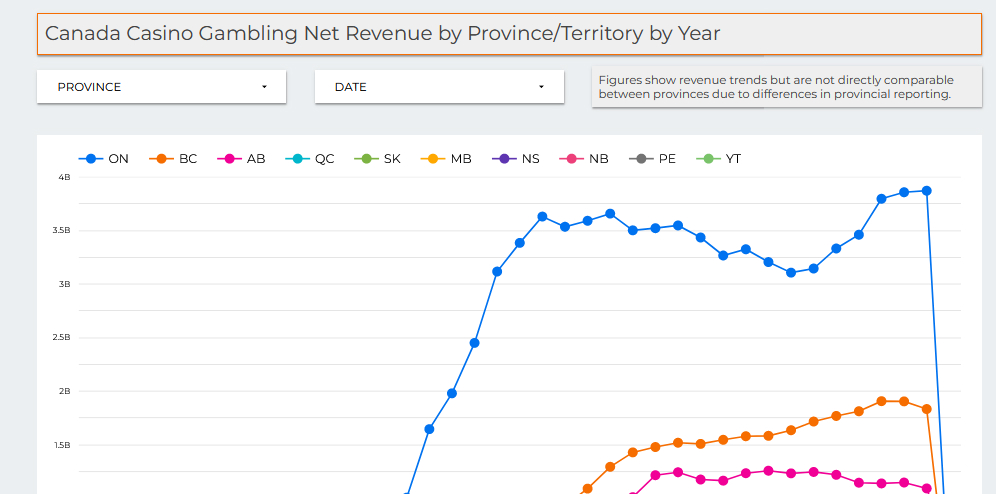
Since Ontario generates most of the casino revenue in Canada, it stands apart from the other provinces. Particularly, the province reported CA$3.8 billion in income. With a combined total of CA$1.8 billion and CA$1.1 billion, British Columbia and Alberta came in second and third, respectively. For the same years, other provinces reported revenues of less than $1 billion CA. The graph below explains this in full detail.
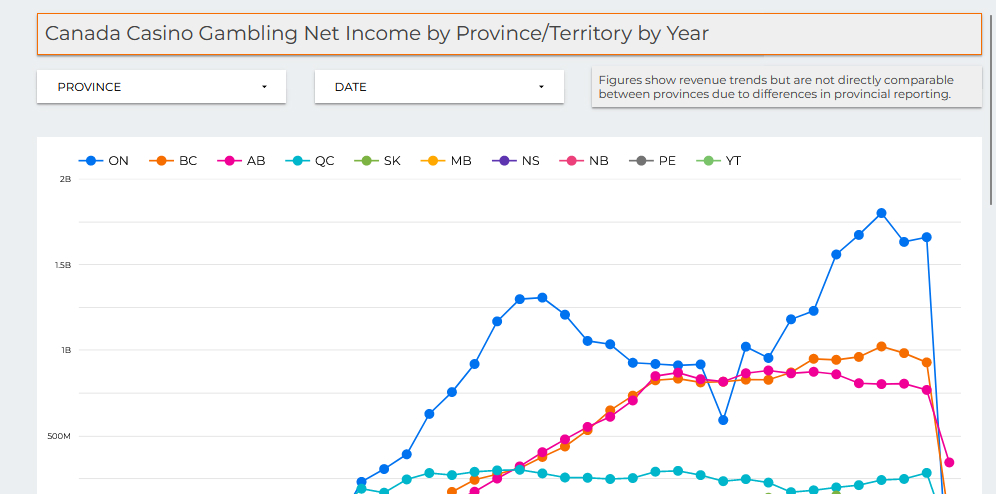
Similar findings are supported by gaming statistics on net casino income, albeit the discrepancy being considerably less. With CA$1.6 billion in income, Ontario takes the top spot once more. With revenues of CA$983 million and CA$804 million, respectively, British Columbia and Alberta firmly hold down the second and third spots. Between CA$26 million to CA$182 million, other provinces including Nova Scotia, the Northwest Territories, and Prince Edward Island have a significantly smaller range. The income gap is depicted in this line graph:
Online Casino Games Gambling Statistics in Canada
Slots are without a doubt the most significant game type in both online and offline casinos in terms of casino games. According to Canadian gambling data, the number of slot machines has been growing rapidly since the mid-1990s. The country counted more than 67,000 different games in 2019.
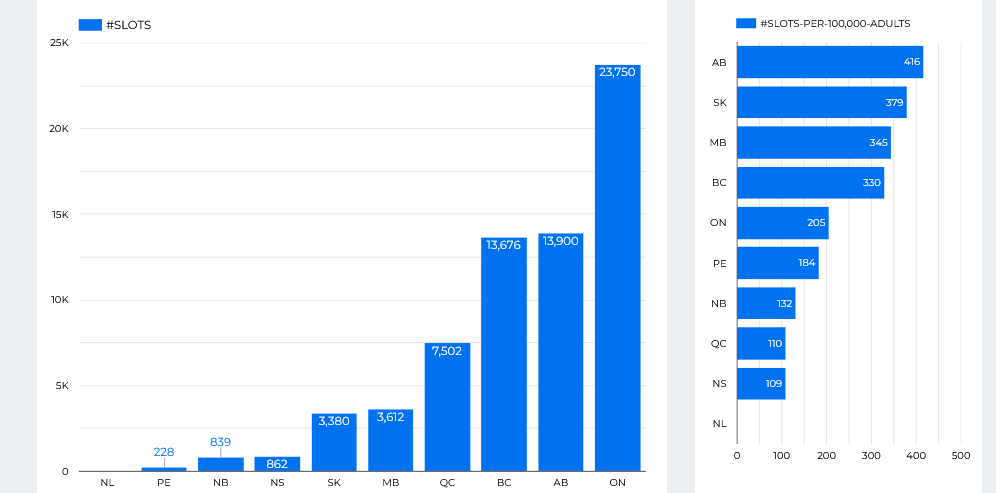
Similar to how revenue is distributed, so do slot machines. With 23,750 games in 2020, Ontario is the province with the most games. Online casinos in Alberta and British Columbia are each home to about 13,700 online slots. What’s more intriguing is how evenly distributed the number of slot machines per 100,000 adults is among the provinces. It should be underlined that interest in slot gaming is high even in less populated regions, such as Saskatchewan. Given the enormous growth of online casinos in Canada in recent years, this is not surprising. The complete gaming statistics for Canada are shown below:
Internet Gambling Statistics in Canada
The statistics around online gambling are not entirely clear. This is probably due to the lack of authoritative information on the subject. Despite having a significant gaming market, Canada’s gambling rules are anything but clear-cut. Since many areas lack government regulation, it is challenging for any organization to compile information about earnings, revenues, player behaviours, etc.
Currently, the only internet casinos with a working regulatory structure are those in British Columbia, Ontario, and Quebec. As a result, they have the most comprehensive and trustworthy long-term online gaming statistics, compiled from information supplied by authorized operators.
Licensed gambling businesses in Canada have been reporting sharp increases in net income since 2019. The most lucrative gaming establishments in Canada are located in British Columbia, with net revenues of CA$421 million reported in 2021. With CA$295 million and CA$244 million respectively for the same year, Ontario and Quebec rank quite similarly. These Internet gambling statistics are somewhat surprising considering that Ontario generally leads the nation in all other gaming-related ventures. This may indicate that British Columbia is poised to play a larger role in the growth of the online gaming industry.
Conclusions
It is obvious that the popularity of legal gambling is growing in Canada. The average Canadian gambler plays more every year, according to statistics on both land-based and online gambling. In the majority of categories, Ontario has reported the largest revenue and income. Online casinos in Alberta and British Columbia often compete against one another. Little is noteworthy about the remaining provinces. The areas where present and incoming businesses will concentrate their efforts in the future are obvious.